A Proposal · 2026
The QTIPOC
CookOut
A liberation technology for QTIPOC freedom, joy, and community
"We build our temples for tomorrow, strong as we know how, and we stand on top of the mountain, free within ourselves"
In 1926, a group of young Black queers in Harlem published a magazine called FIRE!! — unapologetically queer, proudly resistant to elite capture. It ran up massive debts. It suffered a mysterious office fire. It was considered a failure. A hundred years later, we're still reading it.
We are trying again. Different technology. Same fire.
What's in Here
This document moves from why to how to what if. You don't have to read it in order, but if you read nothing else, read the next section.
The Underpinning
What We're Building And Why
Liberation technology. Modern ritual. Ancestral wisdom. The theoretical foundation in three minutes.
Foundation
What We're Inheriting
The ancestral capacity. The three tiers. The structure.
Five Phases
The Work
Inviting. Cooking. Serving. Hosting. Cultivating. Layered, not linear.
Imagination
The Stories
Six possible futures. The transformations we believe become possible.
Knowledge
The Second Pot
Community-owned research. Ancestral Intelligence vs. Artificial Intelligence.
Principles
What Holds
The non-negotiables. Rest, rotation, trust, disagreement.
Sustainability
The Long Haul
Solidarity infrastructure. Building to last beyond any grant cycle.
Closing
The Invitation
You're invited.
What We Are Building
We are pump-priming community investment to establish a new liberation technology — the QTIPOC CookOut — activating ancestral wisdom and lessons from our lived experience, to co-create a vibrant and dynamic, annually observed, modern ritual for QTIPOC freedom, joy, and community.
Every word in that sentence does work. Here is what each one means and why it matters for what we're proposing.
But first, the mechanism. Malidoma Patrice Somé identifies the causal chain:
"When we are connected — to our own purpose, to the community around us, and to our spiritual wisdom — we are able to live and act with authentic effectiveness."
Connectedness → purpose → usefulness → authentic effectiveness. This is not inspirational language. It is a description of how connection produces transformation. QTIPOC denied connection are denied the conditions for authentic effectiveness. The CookOut restores those conditions — not by providing services, not by advocating for policy change, but by rebuilding the relational infrastructure that systems of oppression have dismantled.
The terms below describe how.
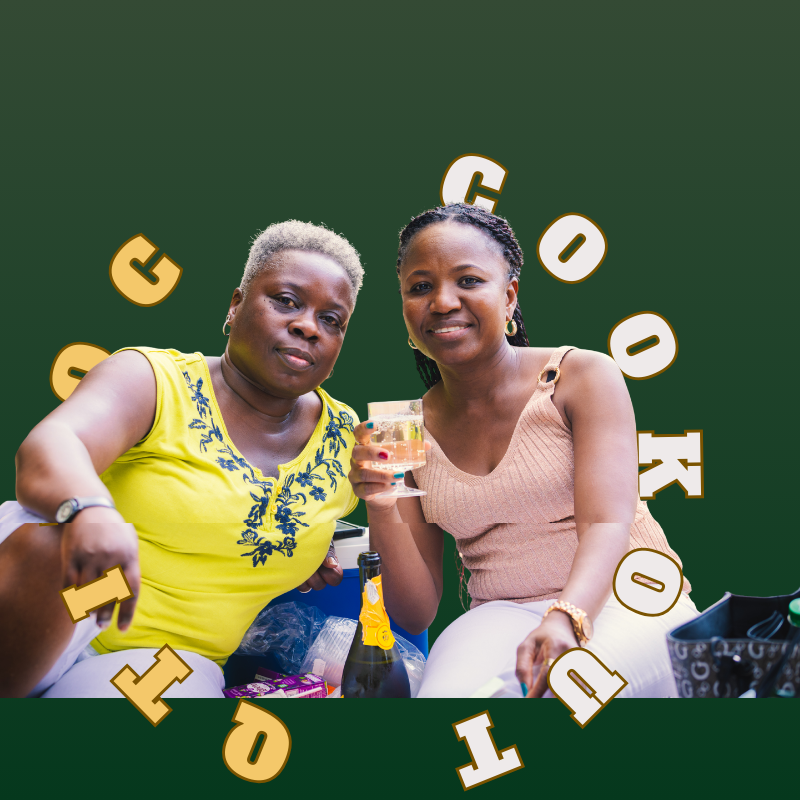
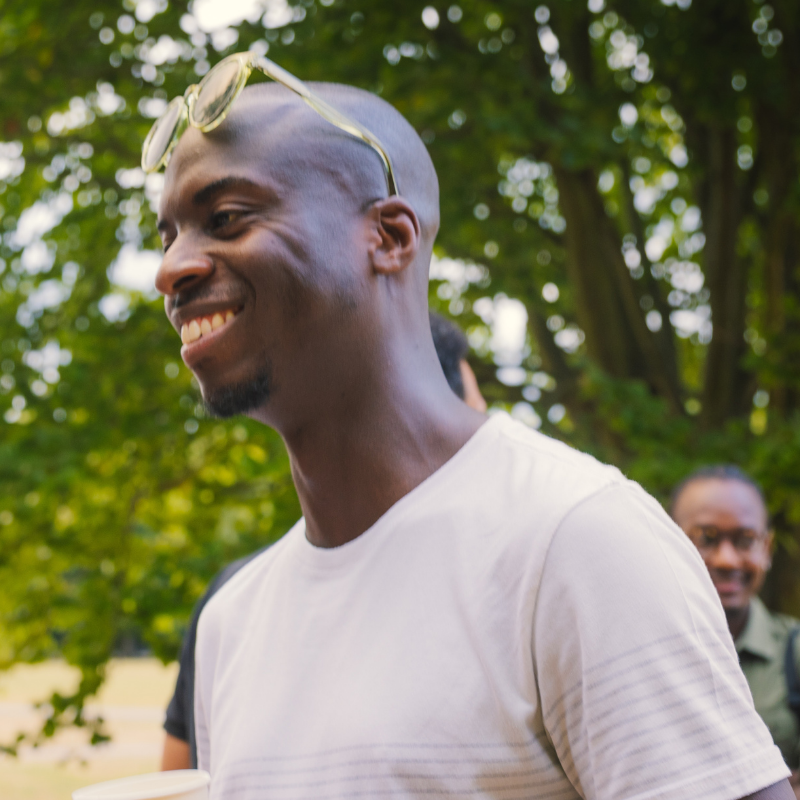
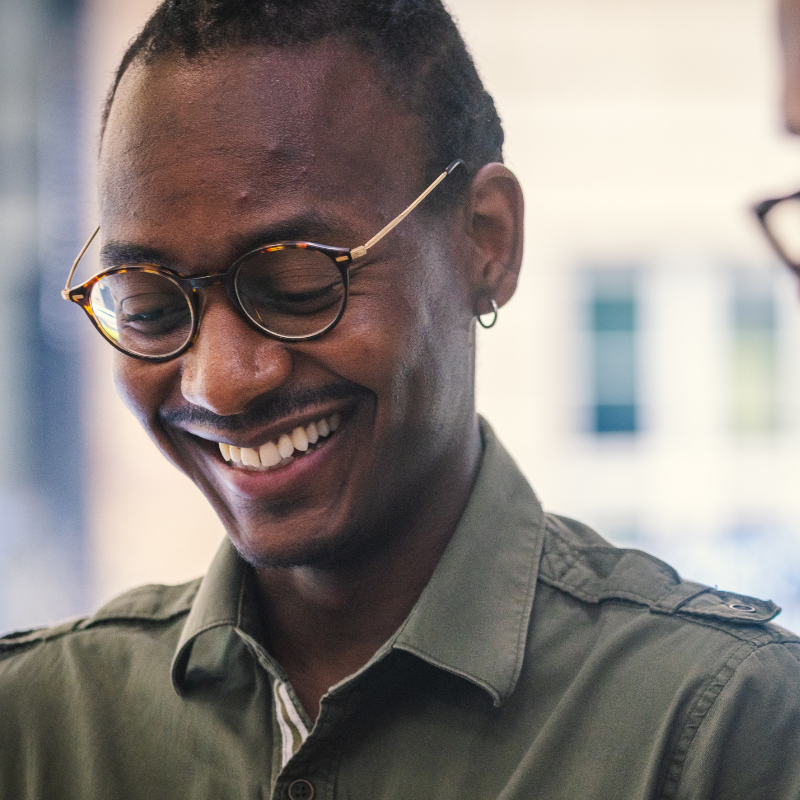
The CookOut is a liberation technology: inputs transformed through gathering into outcomes, feeding back into itself.
Liberation Technology
Technology is the practical application of knowledge to achieve a human purpose — creating tools, systems, or methods that make new things possible or existing tasks easier.
Liberation technology is technology whose human purpose is freedom.
The cookout is a liberation technology. It is not a metaphor for community. It is the technology — the practical system — through which Black communities have organised mutual aid, transferred knowledge across generations, maintained cultural identity, and practised collective joy under conditions designed to prevent all of these things.
Like any technology, it can be studied, understood, adapted, and taught. Unlike most technologies currently on offer, it was designed by us, for us, and it works.
What we are proposing is not to use the cookout as a theme for a programme of activities. We are proposing to establish the CookOut as a technology — to understand how it works, adapt it for QTIPOC communities in Britain, and make it available as a tool that communities can operate for themselves.
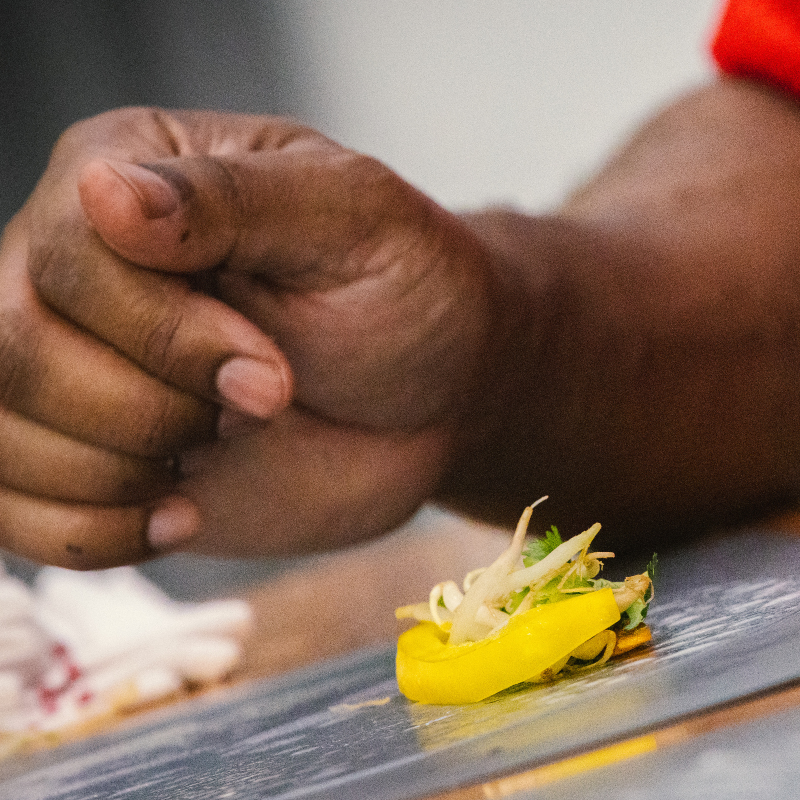
Ancestral Wisdom
Every global majority society has queer ancestry. Not as anomaly or exception, but as integral to the fabric of social, spiritual, and cultural life. Colonialism, and the racism and homophobia it installed as governing logics, severed many of us from this knowledge. Queer erasure and denialism continue to do so.
Ancestral wisdom, in the context of the CookOut, means two things simultaneously:
Recovering — drawing on the rich heritage of queer existence across African, Caribbean, South Asian, East Asian, and Indigenous traditions. Not as historical curiosity, but as living resource. Our ancestors solved problems we are still facing. Their solutions are available to us if we know where to look.
Decolonising — actively dismantling the legacies that tell us our queerness is foreign, imported, or incompatible with our cultures. The CookOut is a space where QTIPOC people practise being whole — culturally rooted and queer, diasporic and grounded — because the ancestral wisdom we're activating says we always were.
Modern Ritual
Ritual is a repeated, structured sequence of actions that holds symbolic, cultural, or social significance. Rituals create social cohesion, communicate cultural values, provide structure, and help people manage change and conflict.
The CookOut is designed to become a modern ritual — not a one-off event, not a programme with a start and end date, but an annually observed practice that QTIPOC communities in Britain come to regard as theirs.
This distinction matters enormously for practical planning:
- ◉ Events need to be organised each time from scratch. Rituals have a structure that persists; what changes is what the community brings to the structure each year.
- ◉ Events are attended. Rituals are observed — they mark time, honour what has passed, and orient participants toward what comes next.
- ◉ Events end when funding ends. Rituals are sustained by the community that needs them. Once a ritual is established — once it has been repeated enough times that people carry its meaning — it continues because people will it to continue.
- ◉ Events produce outputs (reports, media, data). Rituals produce transformation — in participants, in relationships, in the collective understanding of who we are.
The five-year structure of the CookOut is not a five-year programme. It is the minimum time required to establish a ritual — to repeat it enough times, with enough depth, that it becomes self-sustaining.
Pump-Priming
In equity-focused social interventions, pump-priming refers to initial, limited funding or support provided to catalyse new projects, build capacity, and demonstrate value — thereby attracting sustained investment and enabling marginalised communities to scale solutions without ongoing dependency.
The CookOut requires pump-priming because a liberation technology does not appear fully formed. It must be:
- ◉ Designed — the ritual structure, the relational methodology, the knowledge infrastructure
- ◉ Tested — through early iterations that reveal what works, what doesn't, what the community actually needs versus what organisers assumed
- ◉ Documented — so that the technology is transferable, not dependent on the original organisers
- ◉ Demonstrated — so that funders, partners, and (most importantly) QTIPOC communities themselves can see that it works
After pump-priming, the CookOut should be operable by any QTIPOC community with the desire to hold one. The local tier — kitchen tables, living rooms, self-organised gatherings — is the endgame, not the afterthought. National and regional tiers exist to create the conditions for local self-organisation, then to support without controlling.
This is the opposite of the standard funding model, where national activity is the "real" programme and local activity is the "impact." In the CookOut, local activity is the technology in use. National activity is the R&D.
Initial investment creates the conditions for community self-sufficiency. The crossing point is where ownership transfers.
Co-Creation
Radical community co-creation is an approach to collaboration that centres power redistribution, structural transformation, and community-led agency — moving beyond surface-level consultation to ensure systematically marginalised groups define goals, shape solutions, and retain control over processes that affect their lives.
In the CookOut, co-creation is not a methodology applied to a pre-designed programme. The programme is the co-creation. The ritual structure, the knowledge produced, the cultural artefacts, the relational networks — all of these are outcomes of QTIPOC communities gathering and making together. They cannot be designed in advance, because the design is the gathering.
This means:
- ◉ The five phases describe types of activity, not prescribed activities. What happens within each phase is determined by the communities doing the work.
- ◉ Regional variation is not a problem to be managed. It is the technology working correctly — different communities adapting the ritual to their conditions.
- ◉ The Knowledge Fire (the research and documentation strand) is not evaluation imposed from outside. It is communities studying their own practice and deciding what matters.
Co-creation, in this framing, is inseparable from the BLKOUT principle Trust the People: the most resourceful, imaginative, courageous, and wise folk are the QTIPOC themselves.
Why a CookOut?
Why not a conference, a retreat, a festival, a summit? The cookout does things that other gathering forms cannot:
Nourishment
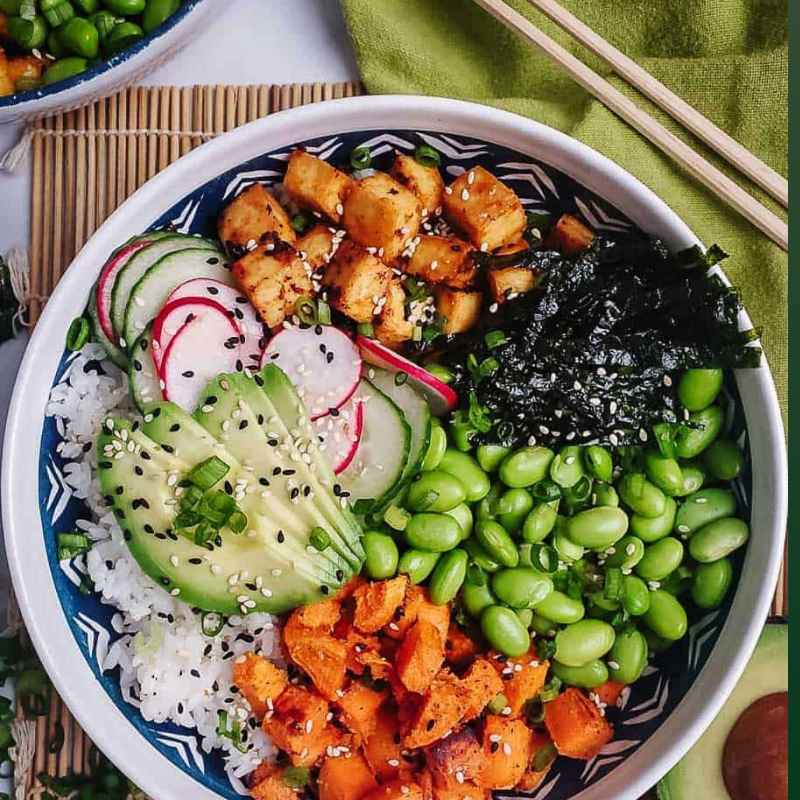
It centres nourishment. The primary act of a cookout is feeding each other. Not networking, not presenting, not skill-building (though these happen). The organising logic is care, not content.
Intergenerational
It is inherently intergenerational. Cookouts are not age-segmented. Elders and young people occupy the same space, performing different roles but present to each other. The conditions for knowledge transfer are built into the form.
Informal
It is inherently informal. The informality creates conditions for unstructured connection — the kind that produces genuine relationships rather than "networking."
Replicable
It is replicable without permission. Anyone can hold a cookout. You do not need a venue, a budget, a committee, a funder. Conferences require institutions. Cookouts require people.
Proven
It is already proven. The cookout is not an innovation. It is an ancestral technology with generations of evidence behind it. We are not inventing. We are activating.
Queering the Local
It queers "the local." By extending "local" to mean affinity as well as geography — trans diaspora, disabled-led spaces, immigrant communities, elder networks — the CookOut adapts a place-based practice for a scattered, digitally-connected community without losing its groundedness.
Anti-Capture
It resists elite capture by design. A cookout's power is in its ordinariness. It does not require charismatic leaders, celebrity endorsement, or institutional prestige. Cookouts distribute the means of production to everyone with a kitchen.
What We're Inheriting
"The cookout is a form of Ancestral Intelligence...one of many ways Black people have survived generations of oppression designed to stop us from organizing for our liberation."
"Human beings long for connection, and our sense of usefulness derives from the feeling of connectedness. When we are connected — to our own purpose, to the community around us, and to our spiritual wisdom — we are able to live and act with authentic effectiveness."
QTIPOC in Britain are isolated. Not by accident but by design. The systems we inhabit — white supremacy, patriarchal manhood, capitalism — need not actively persecute us. They need only exist to render us invisible, to make our lives precarious, to deny us meaningful connection. We are scattered geographically, often the only one in our workplace, family, street.
But we carry something these systems cannot touch: our capacity to create beloved community. To feed each other. To tell our stories. To understand each other. To heal.
The CookOut takes this capacity — this ancestral wisdom — and gives it a structure. Not a programme structure imposed from above, but a ritual structure that communities can make their own. A liberation technology: proven, adaptable, and ours.
Three Tiers
National
Diaspora Rainbow
The research and development tier.
Annual gathering. Coalition stewardship. Shared methodology. Where the ritual is designed, tested, documented, and demonstrated.
Regional
Partner-Led
The adaptation tier.
Quarterly CookOuts. Skill-sharing. Documentation. Where the ritual is adapted to place, affinity, and local conditions.
Local
Self-Organised
The technology in use.
Kitchen tables. Living rooms. The invitation you make yourself. Where the real fire starts — and where it sustains.
Relationships held between tiers by digital — not as platform, but as campfire you can gather around between gatherings.
National exists to serve Regional. Regional exists to serve Local. The technology multiplies as it moves inward.
The phases layer and overlap. They are not steps. They are temperatures.
Phase One · Delivery Department
Inviting
Relationships
Building the relational infrastructure of the ritual
"... if you have come because your liberation is bound up with mine, then let us work together."
"INVITING IN shifts traditional power dynamics that benefit people in positions of privilege by acknowledging that no one is owed or should expect to have access to information about people, especially people that they are not in a relationship with"
Activities
National
- Convene coalition partners
- Set methodology of invitation
- Train regional coordinators
- Build digital introduction spaces
Regional
- Map local QTIPOC networks
- Build trust relationships
- Identify who's missing
- Reach across affinity boundaries
Local
- The personal invitation
- "I want you here"
- The text, the call, the door
- Queering the local
The CookOut begins before people arrive. It begins with knowing who you're asking to show up, and why. Not broad marketing. Not demographic targeting. Genuine invitation.
This means regional coordinators who are embedded in their communities, who know people. Invitations rooted in relationship: "I trust you. I know you. I'm vouching for you."
Queering the local. Yes, there are geographic regions — Bristol, Edinburgh, Cardiff, London. But also affinity networks that cut across geography: trans diaspora, disabled-led organisers, young people, elders, artists, immigrant-led spaces. Your local is what you choose.
No statistics. No desperate reaching for "diversity." Just: people we trust, doing the work thoughtfully.
What this produces for the technology
- ◉ Relational map of QTIPOC networks across Britain — who knows whom, where trust lives
- ◉ Regional coordinators embedded in community, trained in relational methodology
- ◉ Digital spaces where people begin to meet before gathering — low-stakes, consent-based
- ◉ A network that knows itself — not just who's in it, but what it's capable of
Phase Two · Delivery Department
Cooking
Production
Creating the cultural content of the ritual
"Trauma isolates; the group re-creates a sense of belonging. Trauma shames and stigmatizes; the group bears witness and affirms. Trauma degrades the victim; the group exalts her. Trauma dehumanizes the victim; the group restores her humanity."
"In a trauma-informed organization there is an intentional shoulder to shoulder approach and a focus on breaking down hierarchies."
Activities
National
- Shared methodology development
- AI literacy workshops
- Cross-regional exchange programmes
- Archival infrastructure
Regional
- Shared kitchens, mixed skill
- Skill-sharing: film, music, writing
- Workshops on holding difference
- Filmed teaching segments
Local
- Kitchen table organising
- Recipe as story
- Technique as ceremony
- Elders and young side by side
What we make matters. How we make it matters more.
Conversations between regions showing different ways of understanding queerness, transness, Indigeneity. None is "right." All live together in the archive. Space for people to disagree publicly and learn from disagreement.
QTIPOC as makers and archivists of our own knowledge — not subjects of someone else's study.
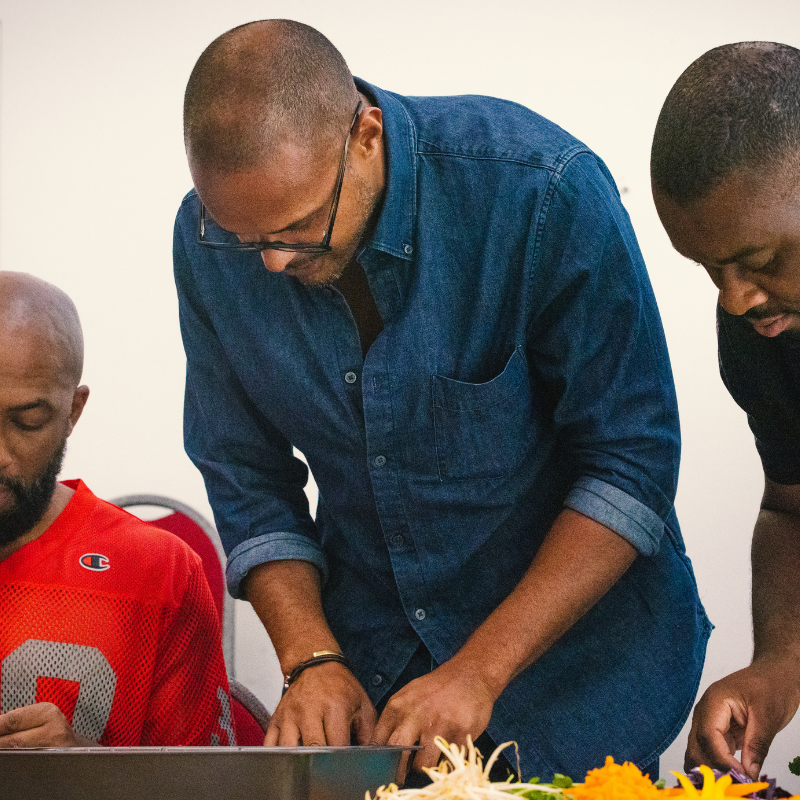
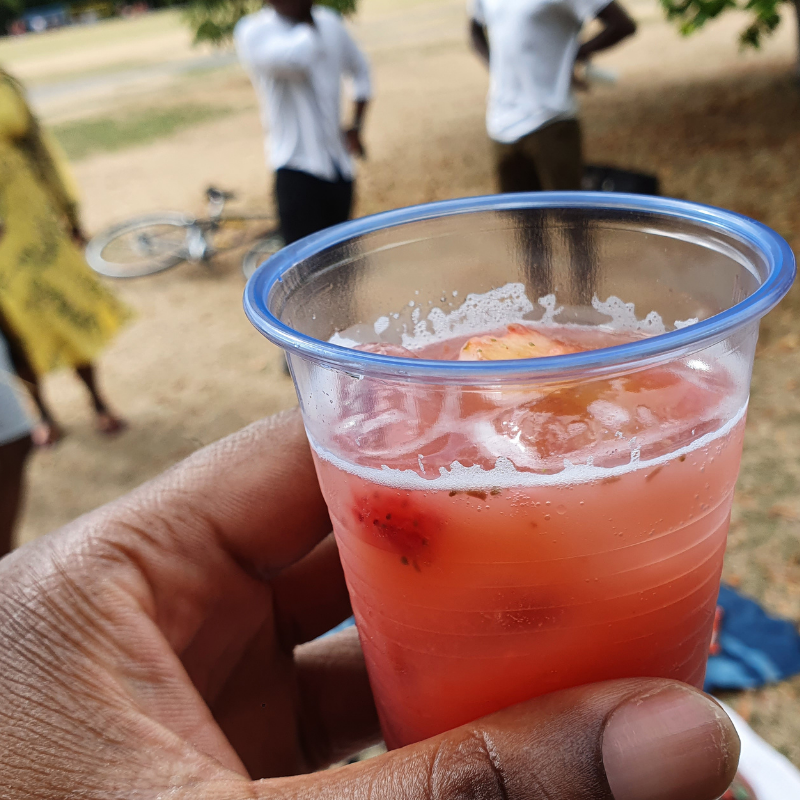
Cookery classes & the annual picnic — BLKOUT, 2024
What this produces for the technology
- ◉ Documented skill exchanges and cross-generational knowledge transfers
- ◉ Regional approaches to queerness and culture, held in productive dialogue
- ◉ Disagreement practiced as creative force, not crisis
- ◉ Growing archive of QTIPOC-produced media, methods, and meaning
Phase Three · Delivery Department
Serving
Health
Designing the distribution logic of the ritual
"Movements are built by the formation of new relationships among people... People move people, and people are moved by examples of people moving people. The 'skilled, intentional, purposeful forming of relationships' on which social networks can be built is essential to the success of social movements — especially insurgent ones."
"Relational organizing focuses on the most important tools at our disposal: our relationships and our ability to talk with one another about things that matter."
Activities
National
- Platform infrastructure
- Living archive curation
- Open access impact data
- Consent frameworks
Regional
- Distribution and access
- Cross-regional sharing
- Mutual care networks
- Asynchronous participation
Local
- The check-in, the meal dropped off
- Resources shared
- Nourishment without platforms
- Care as daily practice
How do we get this to people? On what terms? Who decides? This is about relational distribution, not extraction.
Not a product. A gift. Stories, wisdom, recipes, protocols. Ownership stays distributed. Creators keep rights. No lock-in. Between gatherings, regional coordinators share what's happening.
Asynchronous participation: not everyone can come to the national event, but you're in digital conversation. The ambient warmth reaches beyond those close enough to melt their marshmallows.
What this produces for the technology
- ◉ Living archive of QTIPOC culture, story, wisdom — community-owned
- ◉ Consent-based archiving at every level — participants decide what's shared
- ◉ Ambient warmth — lowered stakes for everyone in range of the fire
- ◉ Health outcomes measurable at population level, not just individual
Phase Four · Delivery Department
Hosting
Art
Performing the ritual
"Art is not just expressive — it is strategic. Artists create shared experiences, visual language, and affective power that galvanize collective action. They help movements tell stories, clarify values, and invite people into participation."
"Art is where we can change the narrative, because it's where people can imagine what change looks and feels like."
Activities
National
- Annual gathering (~100 people)
- 3-4 days, invited relationally
- 50% rotation yearly
- Sectoral witness invitations
Regional
- Exhibitions and showcases
- Art from the cooking, shared
- Performance and installation
- Community screenings
Local
- Living room culture
- Gatherings that don't need permission
- Liming — presence, continuity, just being
- Rest as the work
This is where we gather. Where we actually be together. And rest is not downtime. Rest is the work.
Pride as commodified = prove you exist through visibility, all-night dancing, ecstasy, exhaustion. CookOut = prove you exist through presence, continuity, liming — staying up late lounging and laughing together, just being.
The National Gathering
~100 people. 3-4 days. Invited relationally.
50% rotation yearly — so power doesn't concentrate. Nominated and self-nominated.
Sectoral invitations: Each year, we invite a sector
to witness us on our terms. Year 1: Health. Year 2: Education. Year 3: Employment.
Our existence is no longer a surprise to those who serve us.
Schedule assumes people are tired. Quiet spaces. Care roles visible and valued. Brave Space Agreements co-created. Conflict resolution teams trained in restorative practice. Opening circles, closing circles, music, stories — marking sacred time.
What this produces for the technology
- ◉ A performed ritual that accumulates meaning with each annual repetition
- ◉ Brave space practice modelled, documented, and shared across tiers
- ◉ Sectors that witness QTIPOC on our terms — structural visibility, not performance
- ◉ Artistic output: documentaries, music, writing — spiritual artifacts honouring what happened
- ◉ A culture of rest and presence that challenges the exhaustion economy
Phase Five · Delivery Department
Cultivating
Research
Encoding the ritual's wisdom for transmission
"We cannot fully create effective movements for social change if individuals struggling for that change are not also self-actualized or working towards that end. When wounded individuals come together in groups to make change our collective struggle it is often undermined by all that has not been dealt with emotionally."
Activities
National
- Knowledge synthesis
- Quarterly learning reports
- Community-facing evaluation
- Archive stewardship
Regional
- Documentation and archiving
- Train local sense-makers
- Feed the living archive
- Participatory analysis
Local
- Storytelling as data
- Oral tradition as archive
- Conversation as knowledge
- Passing it on
What do we learn? What do we pass on? This is where we ask: What is the gift we're leaving?
QTIPOC researchers documenting impact. Data belongs to community, not funder. Participants co-analyse: "What does this mean to you?"
By Year 3, a searchable library of QTIPOC culture, wisdom, practice. Young people can see themselves reflected. It's digital, printed, gifted, shared.
What this produces for the technology
- ◉ Community-owned impact evidence that serves us, not surveillance
- ◉ Living archive: digital, printed, gifted, shared — searchable by Year 3
- ◉ Wisdom pipeline: experience → knowledge → legacy
- ◉ Young people who can see themselves reflected and reach for what's possible
- ◉ Documentation sufficient for any QTIPOC community to hold their own CookOut
The Knowledge Fire
The parallel track running through every phase
At every CookOut, there are two things cooking. The first is the gathering itself — the food, the stories, the relationships. The second is the knowledge that the gathering produces.
We are not proposing to study ourselves. We are proposing to know ourselves — rigorously, carefully, on our own terms.
This is what Escoffery means by Ancestral Intelligence. Not artificial intelligence — which takes what we create, processes it out of our sight, and sells it back to us as product. Ancestral Intelligence processes our experience through relationship, through time, through trust. The output isn't a dataset. It's wisdom. And it belongs to us.
To do this well, some of us need new skills — documentation, research methods, digital tools. Others need to remember what we already know how to do — tell stories that carry truth, sit with complexity, recognise patterns through experience rather than algorithms.
Some of us need an upgrade. Others need to use apps they've forgotten they have.
The CookOut builds both capacities simultaneously.
Knowledge Generated at Each Phase
During Inviting
Who knows whom. Where trust lives. What networks exist and where the gaps are. Relational cartography.
During Cooking
How disagreements get resolved. What elders teach. What recipes get adapted and why. Real-time knowledge production.
During Serving
What travels and what doesn't. What resonates in Edinburgh but falls flat in Bristol. The shape of QTIPOC culture across Britain.
During Hosting
What healing looks like. What rest produces. Reflection circles, evening harvests. Collective sense-making as practice.
During Cultivating
Synthesis. What do we know now that we didn't? What has changed? What do we pass on?
Measuring Temperature
We measure — but for ourselves, not for surveillance.
Year 1: Health
Loneliness scales. Mental health. Sense of belonging. New friendships formed.
Year 2: Education
Do curricula change? Do teachers know we exist? Is our knowledge in the room?
Year 3: Employment
Are QTIPOC leaders being hired, supported, valued? Are we building our own?
Years 4-5
Whatever emerges as priority. The community decides what matters next.
The Stories We Imagine
Not case studies. Not beneficiary profiles. A challenge to the organisers — the antidote to the pseudo-psephology of diversity. These are the transformations we believe become possible when the conditions are right.
Theo & Maya
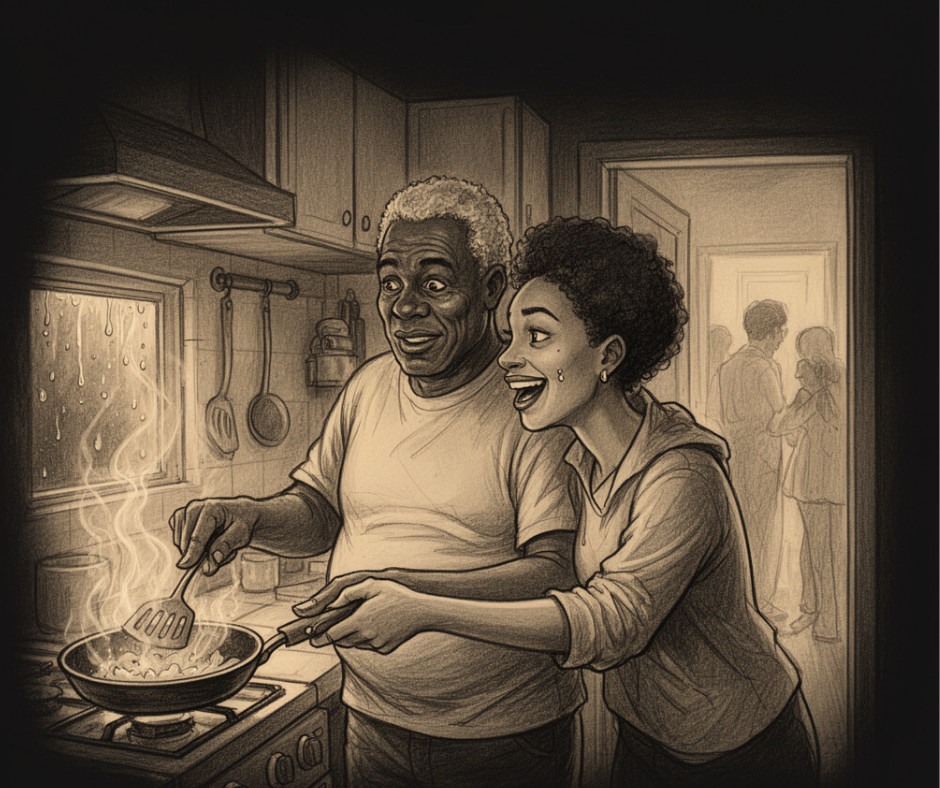
50 & 25 · Lincoln → LondonTheo hasn't been to a queer event in nine years. Not since the last one made him feel like the oldest person who'd ever lived. Maya left Lincoln three weeks ago with a rucksack and her nan's disappointment ringing in her ears. They meet at a CookOut supper club in Peckham — Theo burning garlic, Maya saving it. They don't become lovers. They become kin. Over three years, Theo mentors four young people through the network. Maya trains as a youth worker. By year five, they co-run a supported lodgings scheme for LGBTQ+ young people aging out of care. Twelve young people housed so far. It started because someone sent Theo a text he nearly ignored.
Arena.ai prompt
Monochrome pencil illustration, warm sepia and burnt amber tones on a dark charcoal background. Two figures in a small kitchen — an older Black man (50s, greying temples, kind face, slight belly) and a young mixed-heritage woman (early 20s, short natural hair, nose ring) — standing side by side at a stove. He's gesturing at a pan with mild alarm, she's reaching across him to rescue it, half-laughing. The kitchen is small and steamy, warmly lit. Other people are blurred shapes in the background doorway. Sketchy, loose pencil work — not photorealistic, clearly hand-drawn. Visible pencil hatching and cross-hatching. The emotional register is tender and ordinary. Colour palette restricted to: burnt sienna (#c4632a), amber ochre (#d4a049), cream (#f5efe6) on near-black (#0f0d0b). No text. No logos. Aspect ratio 16:10.
Priya
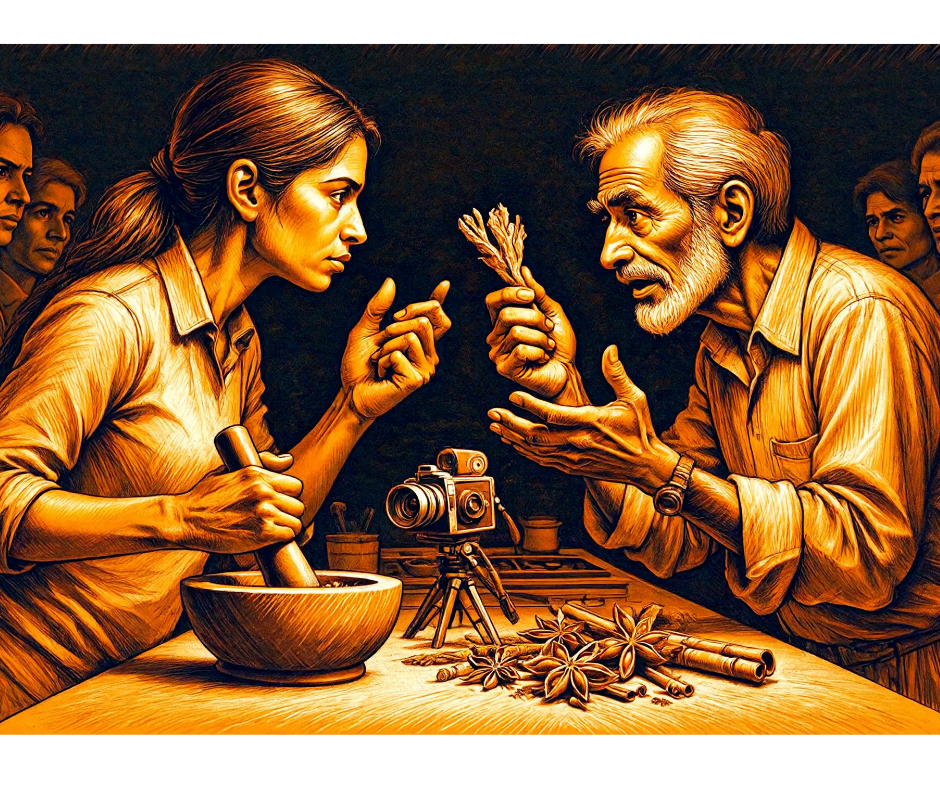
34 · SheffieldPriya is a structural engineer who has never cooked for anyone outside her family. Her grandmother's Keralan fish curry is legendary but unrecorded — measurements lived in the old woman's hands, not in any book. At a CookOut skills exchange, Priya teaches it for the first time. The session is filmed. She stumbles. She gets the coconut milk wrong. Amir, who is sixty-two and Yemeni, shows her his way of tempering spices, and they argue about it beautifully for twenty minutes. That argument becomes a film. The film becomes a series. By year three, the CookOut archive holds forty-seven cross-cultural cooking conversations — each one a record of knowledge that would otherwise have died with the person who carried it. Priya's grandmother watches the first episode on a tablet in Kochi and cries. But the real thing that happened is that Priya stopped being afraid to take up space.
Arena.ai prompt
Monochrome pencil illustration, warm ochre and burnt amber tones on a dark charcoal background. A British-South Asian trans woman (mid-30s, long dark hair tied back, focused expression, engineer's hands) is demonstrating something with a mortar and pestle at a kitchen counter. Across from her, an older Yemeni man (60s, weathered face, white stubble, animated expression) is holding up a different spice, mid-disagreement, one hand gesturing. Between them: scattered spices, a film camera on a small tripod slightly out of focus. Both are leaning in — the body language says respectful creative conflict. Other participants are sketched loosely at the edges, watching. Pencil cross-hatching style, clearly hand-drawn, loose and expressive. Visible grain of the paper. Colour palette: burnt sienna (#c4632a), amber ochre (#d4a049), cream (#f5efe6) on near-black (#0f0d0b). No text. Aspect ratio 16:10.
Kwame
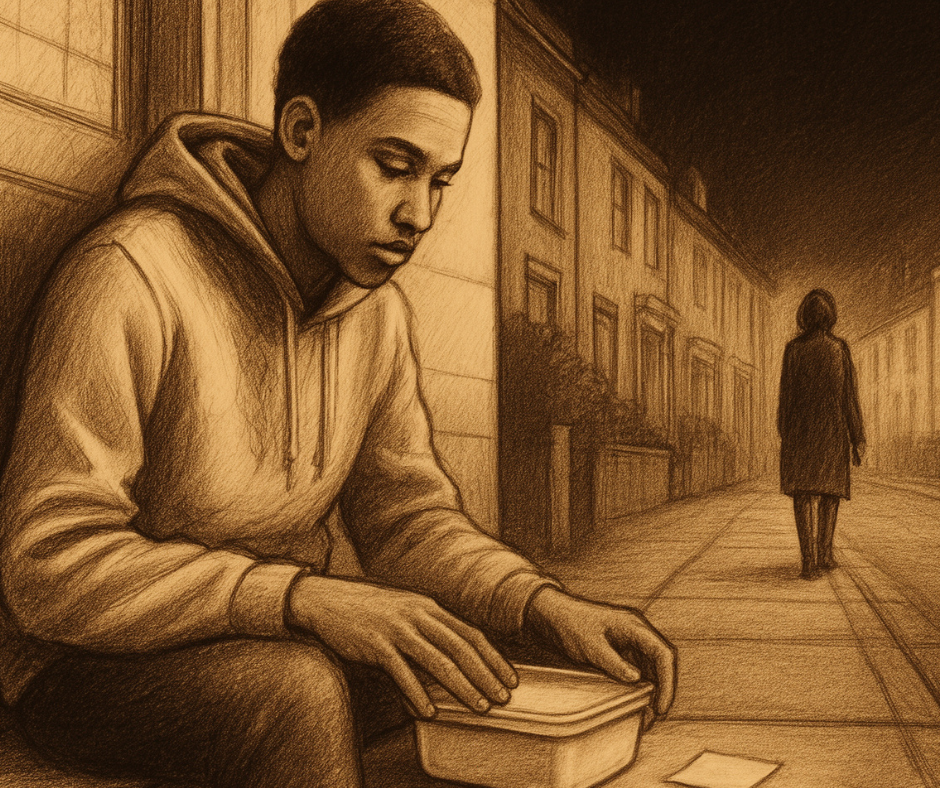
22 · BirminghamKwame stops answering his phone in March. His housemates don't notice for two weeks — he's good at seeming fine. But Denise, who he met at the CookOut's Brum chapter, notices he's missed two sessions. She doesn't call. She drops off food. Jollof rice in a Tupperware with a Post-it: 'Eat this. Text me when you do.' He texts her four days later. She doesn't ask what happened. She just keeps showing up. Over the next eight months, Kwame is held — not by a service, not by a therapist, though he eventually sees one — by a network of five people who rotate check-ins without being asked, who know when to push and when to just sit. By year two, Kwame trains as a peer wellness coordinator through the CookOut's health stream. He designs the check-in rota that held him. He says: 'No one fixed me. They just didn't let go.'
Arena.ai prompt
Monochrome pencil illustration, warm sepia and amber tones on a dark charcoal background. A young Black man (early 20s, slim, wearing a hoodie, looking slightly down but not defeated) is sitting on a doorstep. A Tupperware container of food and a small Post-it note sit beside him. One hand rests on the container. The scene is quiet — a residential street in Birmingham, terraced houses suggested with loose pencil strokes. In the background, a woman's figure is walking away, not looking back, having just left the food. The mood is tender, still, intimate. Not sad — held. Pencil hatching, visible paper texture, sketchy and warm. Colour palette restricted to: burnt sienna (#c4632a), amber ochre (#d4a049), warm cream (#f5efe6) on near-black (#0f0d0b). No text. No logos. Aspect ratio 16:10.
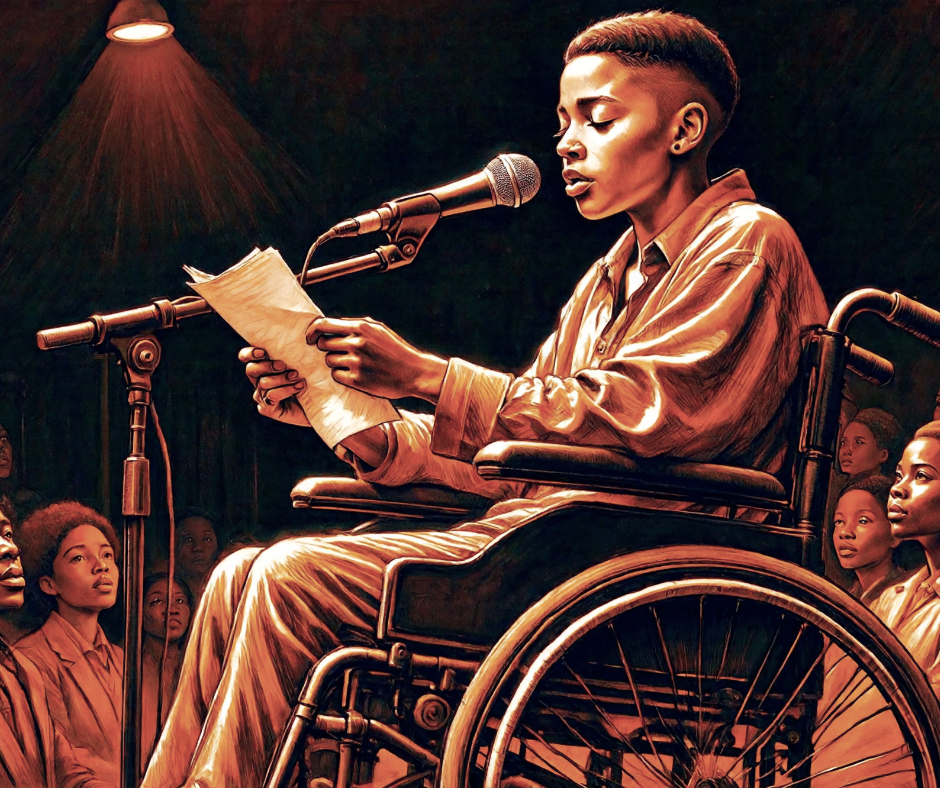
Jaz
28 · Glasgow → The GatheringJaz has written poetry since they were fifteen. They have never read it aloud. Not once — not to a lover, not to a mirror. At the first national CookOut gathering, they wheel up to the open stage because their friend dares them after two rum punches. They read for ninety seconds. Their voice shakes the entire time. Something in the room shifts. Not because the poem is extraordinary — it is, but that's not the point. The point is that sixty QTIPOC are in a room together and someone is showing them something fragile and no one looks away. By the third gathering, Jaz is curating the performance programme. They commission work from QTIPOC artists who've never been commissioned. The pieces are unpolished, specific, sometimes difficult. They are not edited for comfort. An arts council officer comes to the fourth gathering and asks if the work could be 'more accessible.' Accessible to who? Jaz asks. They found out yesterday they've been commissioned to write a poem for the next CookOut yearbook. Wheeling home, they think about how the quality of listening in those rooms — the way people lean in, the way silence is held after someone finishes — has sustained their love of poetry when everything else tried to beat it out of them. They don't need the arts council to tell them it matters. They have a room full of people who already know.
Arena.ai prompt
Monochrome pencil illustration, warm ochre and burnt amber tones on a dark charcoal background. A non-binary wheelchair user (late 20s, mixed heritage, short fade haircut, nose stud, wearing a loose oversized shirt) is positioned at a microphone in a small venue. They are in a manual wheelchair, angled slightly toward the mic stand which has been lowered to their level. Their eyes are closed, one hand holding a crumpled piece of paper, the other resting on the mic stand. They are mid-read — mouth slightly open, leaning into the mic. The wheelchair is part of the composition, not centred or emphasised — just present. The audience is rendered as warm shapes in the foreground and sides — heads, shoulders, the suggestion of faces turned upward, attentive. A single overhead light catches the reader. The atmosphere is electric and intimate simultaneously. Loose pencil work, visible hatching, hand-drawn quality. Colour palette: burnt sienna (#c4632a), amber ochre (#d4a049), cream (#f5efe6) on near-black (#0f0d0b). No text. Aspect ratio 16:10.
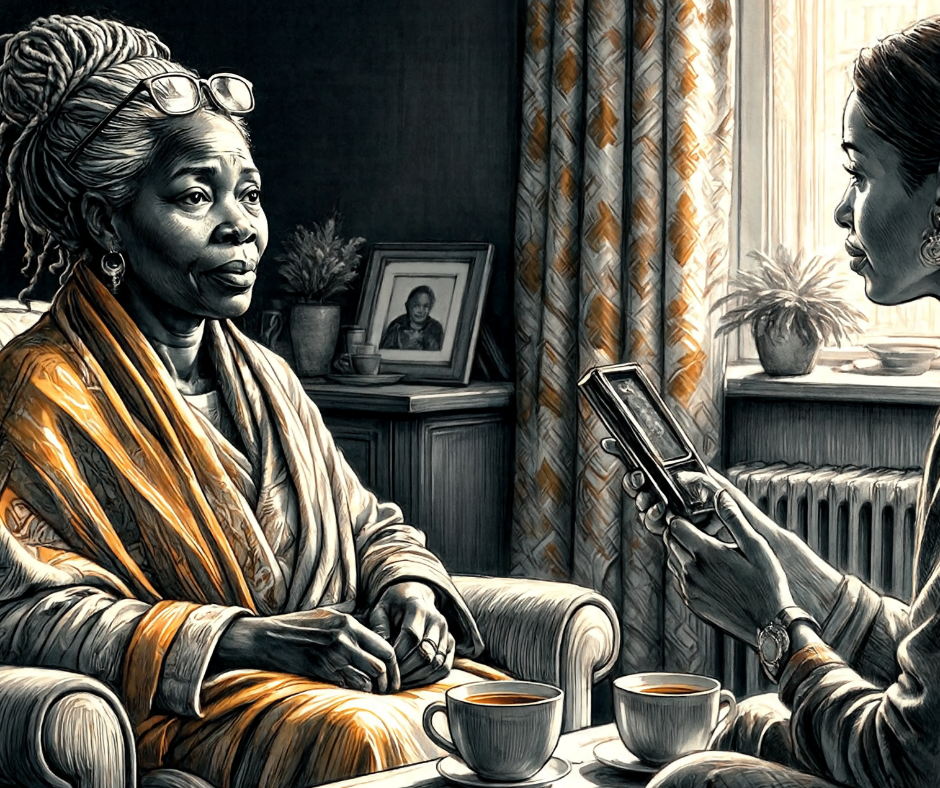
Aunty Bisi
63 · ManchesterBisi has been out since 1986 and in the closet since 1991. Those five years in between — the years when she loved women openly in Lagos before the crackdown — exist only in her memory. No photographs survive. No letters. She has never told the full story to anyone in England. Through the CookOut's oral history project, a young researcher called Folake sits with Bisi for eleven hours across four sessions. Bisi talks about the bar on Allen Avenue. About a woman called Chidinma. About the night the police came and how she bribed her way onto a flight to Heathrow with her sister's passport. Folake cries. Bisi doesn't — she's cried enough. The recording enters the community archive. Three years later, a doctoral student in Ibadan finds it while researching pre-criminalisation queer life in Lagos. She emails Bisi. They talk for two hours. Bisi says: 'I thought those years didn't count because I had to hide them. Now I think they count the most.' The archive holds forty-three stories like Bisi's. Each one a world that nearly disappeared.
Arena.ai prompt
Monochrome pencil illustration, warm sepia and burnt amber tones on a dark charcoal background. An older Nigerian woman (early 60s, greying locs pulled up, strong face, reading glasses pushed onto her forehead, wrapped in a patterned shawl) sits in a comfortable armchair, speaking. Across from her, slightly out of focus, a younger woman (late 20s) holds a small recording device, listening intently. Between them on a low table: two cups of tea, one barely touched. The room is a Manchester living room — suggested with loose strokes: a radiator, patterned curtains, a framed photograph on a shelf (deliberately blurred/vague). Bisi's expression is steady, not emotional — the face of someone who has decided to remember. Pencil hatching, visible cross-hatching in the shadows, hand-drawn warmth. Colour palette: burnt sienna (#c4632a), amber ochre (#d4a049), warm cream (#f5efe6) on near-black (#0f0d0b). No text. Aspect ratio 16:10.
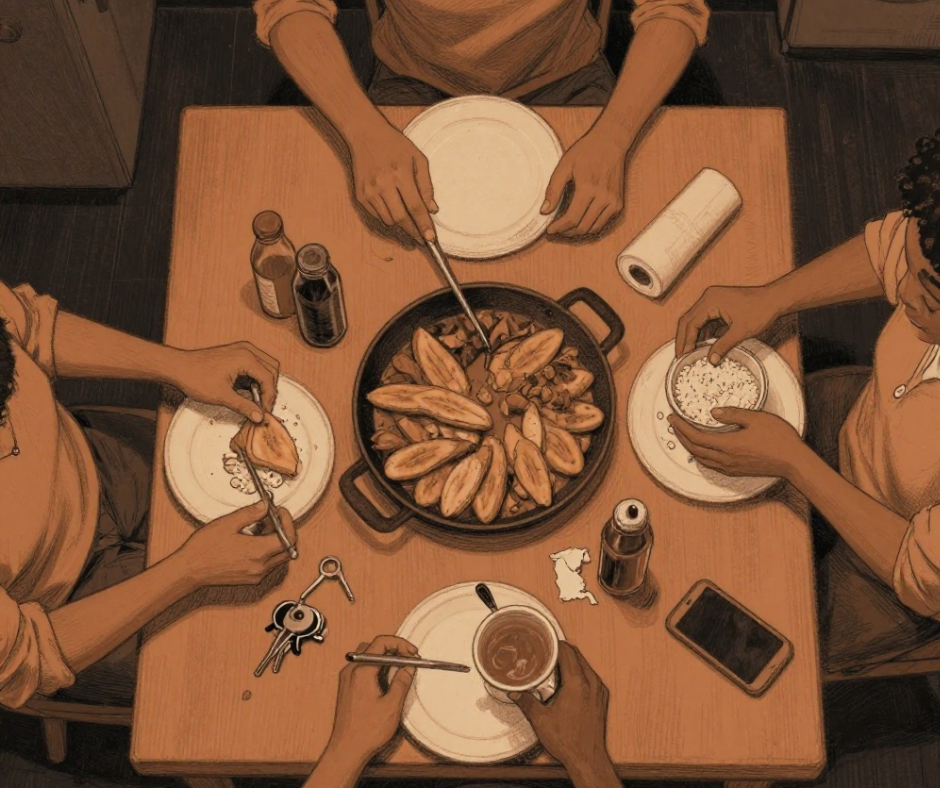
The Lewisham Table
SE13It starts with four people and a bag of plantain. Sade's kitchen, second Friday of the month. No agenda. No funding. No organisation behind it. Just: we cook, we eat, we talk. By month three, there are nine people. By month six, they've outgrown the kitchen and moved to the community centre on Lewisham Way — still unfunded, still no constitution, still just food and talk. Someone suggests a community fridge. They stock it from the surplus of their own cooking sessions. Within a year, thirty households are eating from it. A regional CookOut organiser hears about them and asks to visit. Sade says: 'You can come eat but we're not joining anything.' They don't join. But they share their model. By year four, there are self-organised cooking tables in Handsworth, Moss Side, Toxteth, Chapeltown, St Pauls, Easton, Tottenham, and Brixton. None of them are the same. None of them asked permission. The Lewisham table still meets on the second Friday. Sade still brings the plantain.
Arena.ai prompt
Monochrome pencil illustration, warm ochre and burnt amber tones on a dark charcoal background. Bird's-eye view looking down at a kitchen table. Four pairs of hands are visible — different skin tones, different ages — reaching across plates, bowls, and a large pan of food. Plantain is being sliced by one pair of hands. Another is serving rice. A third is gesturing mid-conversation. The fourth holds a cup of something warm. The table is crowded, alive: condiment bottles, a torn piece of kitchen roll, a phone face-down, a set of keys. Around the edges of the frame, the kitchen is suggested loosely — a fridge covered in magnets, a window with condensation, a washing-up pile. The mood is abundance and informality. Pencil sketch, loose hatching, visible paper grain. Colour palette: burnt sienna (#c4632a), amber ochre (#d4a049), cream (#f5efe6) on near-black (#0f0d0b). No text. No logos. Aspect ratio 16:10.

This will happen. No crystal ball required.
What Holds Across All Phases
Queering the Local
Your local isn't just geography. It's affinity. It's chosen. If where you live is oppressive, you find your people elsewhere.
Rotation Prevents Elite Capture
50% new participants yearly. Leaders cycle. Power doesn't concentrate. Like FIRE!! tried to do — but with infrastructure to sustain it.
Digital Isn't Extraction
The platforms we're offered as replacements for genuine community — TikTok, Instagram, Facebook — take our data, our creativity, our attention, and offer us the illusion of belonging while ensuring we remain isolated enough to be profitable. The CookOut's digital infrastructure does the opposite: it documents, archives, connects. It doesn't own. It serves. Community data sovereignty, not corporate surveillance.
Rest Is Non-Negotiable
Stewardship that burns people out isn't stewardship. It's exploitation in new clothes.
Disagreement Is Creative
All approaches live together. Wisdom emerges from held difference, not forced consensus.
Trust the People
The most resourceful, imaginative, courageous, and wise folk — the QTIPOC themselves. We lowered our expectations. Time to stop.
Small Is All
The ritual works at kitchen-table scale. If it doesn't work there, it doesn't work. National gatherings exist to serve local ones, not the other way around.
Building for the Long Haul
Solidarity infrastructure that outlasts any funding cycle
Most solidarity arrives in bursts. A crisis. A killing. A policy. Communities mobilise, funders respond, organisations scramble to coordinate. Then the crisis recedes, and so does the solidarity. Everyone has to start over next time.
The CookOut is designed to break this cycle. Not by responding harder to the next emergency, but by building the infrastructure that makes sustained solidarity possible — the connective tissue between communities that holds whether or not anyone is watching.
This is what solidarity scholars call transformative solidarity: practices rooted in Black, Indigenous, labour, disability, and queer transnational traditions that produce material shifts — not just statements of support. The CookOut inherits these traditions deliberately.
"When solidarity arrives in bursts — in response to crisis, outrage, or a newly visible injustice — it tends to recede when the crisis subsides. Without sustained infrastructure, organisations have to start over every time a new issue or crisis emerges."
Four Pillars of Solidarity Infrastructure
Sustainable movements require investment across four interconnected pillars. Here is how the CookOut builds each one.
Skills
What people learn to do together
Solidarity doesn't happen by instinct. It requires skills that most institutions never teach: trust-building across difference, navigating conflict without collapse, holding tension without forcing consensus.
The CookOut teaches these skills through the gathering itself. Cooking together is conflict navigation. Sharing a meal across generations is trust-building. Deciding what to make, who brings what, how to accommodate — this is consensus-building dressed as hospitality.
The Cultivating phase makes this explicit: QTIPOC researchers document what works, community members co-analyse their own experience, and the knowledge feeds forward. By Year 3, the skills aren't dependent on any single organiser. They live in the community.
Spaces
Where solidarity is practised, not just declared
Solidarity needs somewhere to happen. Not just venues — physical, digital, and relational spaces where people can strengthen relationships, align strategy, practise political education, create shared vision, and heal.
The CookOut's three tiers are three types of space. Kitchen tables — intimate, self-organised, no permission needed. Regional gatherings — connecting local groups, sharing practice, building the network. National events — the annual ritual that marks time and renews collective purpose.
Critically, the digital layer — the living archive, the Knowledge Fire — creates a space that persists between gatherings. It's not social media. It's not content. It's community memory, held in common.
Scaffolding
Temporary support that enables permanent building
Scaffolding is the temporary framework that supports construction until the structure can stand alone. In solidarity work, this means network weavers, facilitators, coordinators, and sensemakers — people whose job is to hold the space while communities build capacity.
This is exactly what pump-priming is. The five-year structure is scaffolding — not the building itself. National coordination, the stewardship team, the initial funding: all of these exist to create conditions for local self-organisation, then to step back without leaving a vacuum.
The scaffolding comes down when the ritual can sustain itself. When QTIPOC communities hold CookOuts because they will them to continue — not because a funder requires it — the scaffolding has done its work.
Structures
What endures after the scaffolding comes down
Structures are the durable systems that remain: governance practices, conflict-transformation protocols, accountability mechanisms, shared agreements about how power moves.
The CookOut's structures are embedded in the ritual itself. Rotation prevents elite capture — 50% new participants yearly, leaders cycling, power distributed. The Knowledge Fire ensures community-owned evaluation, not funder-imposed metrics. Data sovereignty means the community decides what is measured and who sees it.
These are not policies stapled onto a programme. They are how the CookOut works. The structure is the ritual. The ritual is the structure.
Why This Is Different
Co-liberation
Our freedom is bound together. The CookOut doesn't serve a target group. It creates conditions where QTIPOC communities discover that their struggles are connected — and that their liberation is mutual. Trans and cis, elder and youth, African and South Asian, disabled and non-disabled. Different experiences, shared horizon.
Co-conspiratorship
Risk-taking, not risk-management. Solidarity that redistributes power is uncomfortable. The CookOut doesn't smooth over difference — it holds it. Disagreement is creative. Conflict is navigated, not avoided. This is harder than running a nice event. It is also the only way things actually change.
Collective Agency
Coordinated action from shared understanding. When the infrastructure is in place — skills built, spaces held, scaffolding supporting, structures enduring — communities don't need to wait for the next crisis to act together. They already know how. They already know who. The fire is already burning.
The question is not whether QTIPOC communities can build solidarity. We have been doing it for centuries — at kitchen tables, in living rooms, at cookouts. The question is whether we invest in the infrastructure that allows this solidarity to scale without being captured, endure without burning people out, and deepen with each generation.
That is what the CookOut is for. Not a programme that runs for five years and writes a final report. A technology that communities carry forward — adapting, iterating, making it theirs — long after the pump-priming is done.
This section draws on
"How to Build Solidarity Infrastructure for the Long Haul"Nonprofit Quarterly, 2025
Diaspora Rainbow Coalition
Enter the shared password to access the project plan
Project Plan
For Diaspora Rainbow Coalition review
Working Draft
February 2026
A comprehensive 5-year project plan for establishing the QTIPOC CookOut as a self-sustaining liberation technology. This document is for discussion and development with coalition partners.
Structure & Strategy
- ◈ Work Breakdown Structure (6 workstreams)
- ◈ Critical Path Analysis & dependencies
- ◈ 30+ milestones across 5 years
- ◈ Gantt overview & Year 1 quarterly plan
- ◈ Governance & steering structure
Budget & Sustainability
- ◈ Full budget with pump-priming trajectory
- ◈ Staffing model (Knowledge Fire growth)
- ◈ Arts grants & capacity building lines
- ◈ Funding strategy with 10 prospective funders
- ◈ Risk register & M&E framework
"We must recognize and nurture the creative parts of each other without always understanding what will be created."
We don't know exactly what will emerge from QTIPOC gathering together intentionally, with care, over time. We know it will be fierce and beautiful and honest. We know it will matter.
If you feel something when you read these words — if you can see what it means to build a liberation technology together, to establish a ritual that will outlast any of us —
You're invited.

The QTIPOC CookOut · 2026 · qtipoccookout.com